Canada & Society

Alberta First Referendum

Alberta did not vote to join Canada. Canada created the province of Alberta. But the province wasn’t empty. Americans had moved in wanting to escape American government. If they had been asked for becoming a province of Canada, there is no answer to give. They were there and they weren’t going to leave.

On July 20, 1905, Parliament established Alberta from part of the Northwest Territories. There was no referendum in which an existing Alberta nation chose Canada. Alberta began as a Canadian province, created as part of a national project to settle and develop the West.

That history matters because, more than a century later, Alberta increasingly speaks about itself in the language of a political nation: our money, our resources, our pension, our police, our laws, our future.

How did a Canadian province develop such a powerful sense of political distinctiveness? It didn’t just happen because of Pierre Trudeau or Justin Trudeau or the federal Liberal party. History tells us otherwise.

The historian Nelson Wiseman identified an unusually strong American influence on Alberta politics: rugged individualism, market capitalism, equality of opportunity, suspicion of centralized government and socialism, and the ideal of the self-made individual.

The federal government actively recruited settlers to the West with the promise of land, opportunity, independence and self-reliance. Canada wanted people who would build farms, communities and businesses. It succeeded.

But the political culture encouraged by that settlement strategy was not necessarily comfortable with the national government that had made the settlement possible.

The result was a distinctive Alberta political temperament.

It is my land. It is my work. Why should government take my money? Why should someone else tell me what to do?

Those sentiments have persisted. Over time, the individual became the taxpayer, the taxpayer became the producer, and the producer became Alberta.

The question “Why should government interfere with me?” gradually acquired a provincial form:

“Why should Ottawa interfere with Alberta?”

That transformation is central to understanding Alberta today.

It also helps explain why Alberta’s political history cannot be reduced to separatism. Alberta has produced Social Credit, the United Farmers, Progressive Conservatives, Reform, the Wildrose movement and the modern United Conservative Party. These movements differed enormously. Yet beneath the differences ran a recurring concern with individual freedom, property, taxation, economic independence and resistance to centralized authority.

The political institutions changed. The vocabulary changed. The underlying instinct proved remarkably durable.

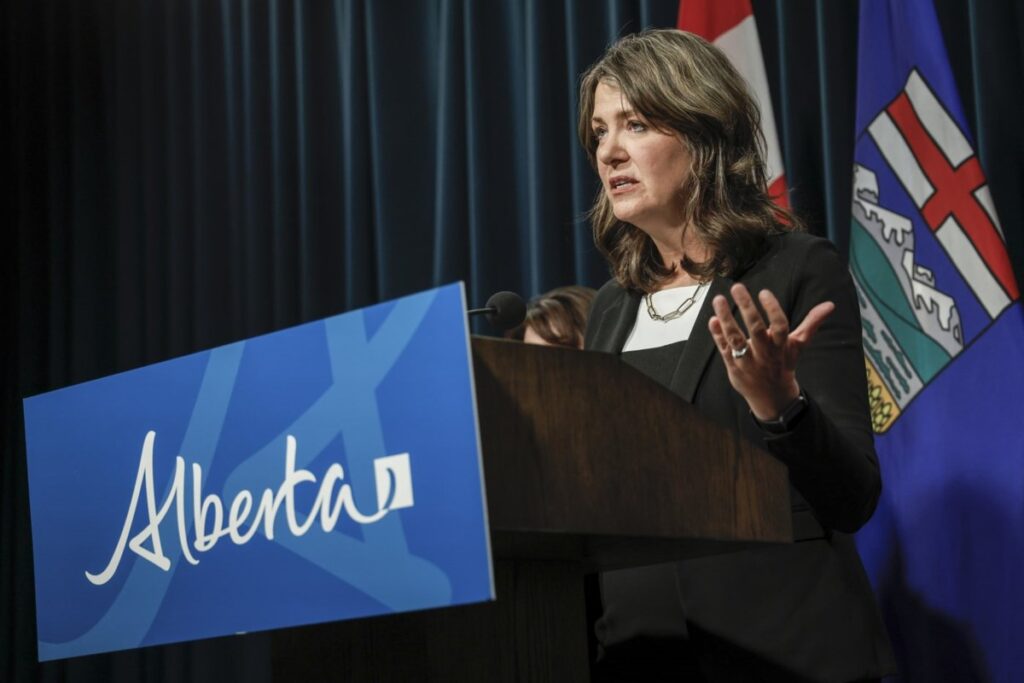
And this is where Danielle Smith’s political history becomes significant.

Smith did not invent this political culture. She emerged from it. Her political formation took place in the conservative intellectual environment of the University of Calgary, the Calgary School, the Fraser Institute, property-rights politics and the Wildrose movement. Her career moved through institutions and movements that emphasized individual liberty, free markets, limited government, property rights, and resistance to federal intervention. Tom Flanagan, one of the most influential figures in that intellectual world, later managed Smith’s 2012 Wildrose leadership campaign.

The importance is that the same political values associated with Alberta’s formative American influence were being reproduced, intellectually developed and transmitted through Alberta’s modern conservative institutions.

The frontier settler’s political instinct did not disappear when the frontier disappeared. It acquired think tanks. It acquired universities. It acquired political parties. It acquired radio and television personalities. It acquired policy papers. And eventually it acquired a premier.

It explains why the politics of individual autonomy can become politics of provincial autonomy. It also explains why the language of grievance so often points outward.

Why should Ottawa take Alberta’s money?
Why should Ottawa control Alberta’s resources?
Why should Alberta pay for provinces that contribute less?
Why should Ottawa tell Alberta how to run its economy?

These are legitimate political questions. But they are incomplete questions.

A federation cannot be understood simply by calculating what one province sends to Ottawa. It has to be understood by examining what each level of government does, what each receives, what each contributes and what each is responsible for. That is the part of the Alberta conversation that is often missing.

The political argument can become a ledger of grievances against Ottawa without an equivalent ledger of Alberta’s own decisions. This does not make Alberta’s grievances illegitimate. It makes them incomplete.

The distinction matters because Alberta’s current political project goes considerably beyond the traditional complaint that Ottawa is meddling too much.

Danielle Smith describes her objective as a sovereign Alberta within a united Canada.

The more useful question needs to ask what powers Alberta seeks.

Alberta has examined greater provincial control over taxation, resources, pensions, policing, immigration, social programs and international agreements. The Sovereignty Within a United Canada Act provides a mechanism for the province to resist federal measures it considers harmful to Alberta.

None of this automatically means independence. A province can demand greater autonomy while remaining a province. But there is a constitutional question hiding underneath the terminology.

If Alberta eventually controls its own income-tax collection, substantially reduces federal authority over its resources, establishes its own major social programs, pursues its own international economic relationships, controls more policing and immigration functions, and increasingly treats federal legislation as something Edmonton may accept or reject, what remains of the practical authority of the federal government in Alberta?

America has always been in the room

There is another part of this story that Canadians should understand. America did not suddenly return to Alberta.

America has always been in the Alberta story.

It was there among the early settlers. It was there in the political ideas that helped shape the province. It was there in Alberta’s economic dependence upon American markets. It was there in the circulation of conservative and libertarian ideas through organizations and intellectual networks. And it remains there now.

The difference is that the relationship has become more politically consequential. American political networks have developed relationships with Alberta activists and political organizers. Reporting has documented contacts between Alberta separatist figures and American Republican operatives. Other reporting has examined efforts by Alberta advocates to cultivate relationships in Washington and to present Alberta’s resources as strategically valuable to the United States.

That does not establish an American government conspiracy to break up Canada.

It does establish something less dramatic but more important: Alberta’s political struggle is occurring in a North American political environment in which American interests have a direct stake.

And the current American administration has made that environment substantially more dangerous. Donald Trump has repeatedly spoken of Canada as a potential 51st state and has used tariffs as an instrument of pressure against Canada.

For Alberta, this creates an extraordinary contradiction.

The United States is Alberta’s largest external economic partner. Alberta’s political culture has long been unusually receptive to American ideas. Yet the American president is simultaneously challenging Canadian sovereignty. So, what happens when Alberta’s economic interests, Alberta’s political identity and Canada’s national interest do not point in precisely the same direction?

That question became visible during the tariff dispute. Smith has emphasized protecting Alberta and has said she will always put Albertans first. That is understandable provincial politics.

But Canadians are entitled to ask what Canada first means when Canadian sovereignty itself is under pressure. If the United States threatens Canada, is Alberta’s first political

Alberta developed a political culture in which individual independence became a defining virtue. That culture was reinforced by an American influence that was unusually strong during the province’s formative years. Canadian governments helped create the conditions in which that culture flourished. Alberta’s conservative institutions later refined it and turned it into a sophisticated political philosophy.

Today, that philosophy is being applied not simply to the individual but to the province itself.

My property became our resources.
My money became Alberta’s money.
Leave me alone became leave Alberta alone.

The October referendum question is therefore about more than whether Albertans like Ottawa. It is about whether Alberta’s long demand for autonomy has reached the point where many Albertans are prepared to ask whether autonomy is possible without sovereignty.

Can Alberta remain part of Canada while substantially reducing Canada’s authority within Alberta? Can a province demand control over taxation, resources, pensions, policing, immigration and international economic relationships while retaining the benefits and protections of Canadian nationhood?

And if the answer is yes, what does that Canada look like?

Those questions belong to Albertans. But they also belong to every Canadian. Because Alberta did not enter Canada as a sovereign country. The Canadian state created the province in 1905.

For more than a century, Alberta has developed its own political identity within that federation. Now that identity is strong enough to challenge the terms of the relationship that created it.

Why is Alberta angry?

It is:

How far does Alberta want its independence to go?
Canada & Society

Is Canada Broken?

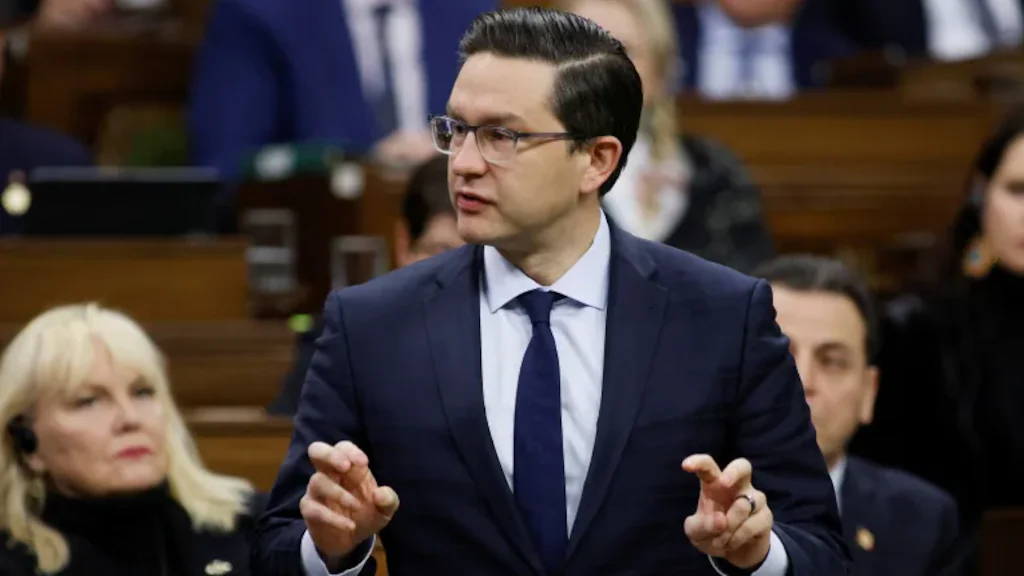
’Everything seems broken,’ Poilievre says in fiery speech ahead of Parliament’s return – January 27, 2023 3:35 PM CBC

For a few years, a mantra has been “Canada is broken.” I am a Canadian and I have family from coast to coast, literally. More than that, my family has been on Canadian soil since the late 1600’s. I was born in Ottawa, and I have a French-Canadian name. A part of Canada, not just geographic, has a hatred for Ottawa and French-Canadians.

Is Canada broken?

First answer: NO! However, Canada is not perfect. Canadians are divided and have always been divided. The current Alberta problem is not really an Alberta problem. It is just the face of a much larger problem. That problem is not one thing, it is an accumulated tension that began when Canada was just Ontario and Quebec, Upper and Lower Canada. My family lived on the dividing line between these two Canadas, along the Ottawa River.

Fractures exist in the political, constitutional, economic and social relationships of our country. Despite them, Canada still functions as a sovereign country. The country is still working as a full democracy regardless of our issues with each other, our governments, and with the relationship to the land we stand on.

So, me being me, I had to dig deep to try and understand why we are so at odds with each other as we struggle with defining and owning the label of being Canadians.

The answers I found make me feel uncomfortable.

Important parts of Canada appear to be broken, and the connections between Canadians are fragile and worsening.

Canada is experiencing polarization. Polarization is disagreement. Polarization has been present from day one – French versus English. We will always disagree but somehow have been able to bridge disagreement and remain a united Canadian family.

Something deeper is festering.: There is a growing disagreement about the legitimacy of the institutions through which disagreement is supposed to be resolved.

This is not an Alberta problem.

Much of the recent discussion has focused on Alberta. The referendum, provincial sovereignty, western alienation, and the possibility of separation are certainly important issues. But Alberta is not the problem. Alberta is the just a single face of the older and deeper issues.

There are vital questions arising from the referendum, Who has legitimate political authority? What does federalism actually mean? What does it mean to be Canadian? Who belongs? What obligations do Canadians have to one another? What is the proper relationship between the federal government, the provinces and Indigenous nations? How much immigration can Canada sustain while maintaining social cohesion? What happens when a provincial government claims a democratic mandate that conflicts with a federal government claiming its own? And perhaps most importantly:

What happens when citizens no longer accept the legitimacy of the institutions that are supposed to settle these disagreements?

Those are Canadian questions. Alberta simply happens to provide an unusually clear window through which to see them.

A democracy cannot function on elections alone. It requires citizens to accept that Parliament, courts, elections, journalism, public institutions and the constitutional system have legitimate authority even when they produce an outcome they dislike. That acceptance is weakening.

Statistics Canada has documented declining confidence in Parliament and the media, and its most recent research shows that only a small minority of Canadians are very hopeful about the way democracy is working in Canada. In 2024, only 12 percent of Canadians aged 15 and older said they were very hopeful about the way democracy works in Canada. Seventeen percent said they were not at all hopeful. Among those who were not at all hopeful, only 11 percent reported high confidence in Parliament, compared with 67 percent among those who were very hopeful.

This does not mean Canadians have stopped believing in democracy. It means that an increasing number of Canadians are losing faith that the democratic system is producing legitimate results. That distinction is critical. There is a profound difference between saying, “I think the government is wrong,” and saying, “The government has no legitimate authority.”

There is another difference between saying, “I don’t trust this newspaper,” and saying, “The entire news media is propaganda.” There is another between saying, “I disagree with this court decision,” and saying, “The courts are politically captured.”

Once enough people cross those lines, democratic institutions can continue to operate while their legitimacy steadily disappears. That is how a democracy can remain formally intact while becoming increasingly difficult to govern.

We are losing a common reality

The information revolution has made the problem considerably worse. There was a time when Canadians could disagree while still receiving much of their information through a relatively small number of common institutions.

That world is gone.

One Canadian watches CBC. Another watches Fox News. Another listens to American podcasts. Another follows Canadian political influencers on YouTube. Another gets political information through Facebook, X or TikTok. Another receives it through a church or activist organization. Another follows foreign media. And increasingly, people encounter information that has been generated, manipulated or amplified by artificial intelligence.

The result is not simply that Canadians have different opinions. They increasingly inhabit different informational realities. That is far more dangerous. A democracy depends upon argument. But argument requires some agreement about what constitutes evidence.

If the evidence itself is regarded as political propaganda, then the argument cannot be resolved by evidence.

The person who disagrees with me is no longer simply wrong. He is deceived. Or corrupt. Or captured. Or part of the problem. And once that happens, compromise becomes betrayal.

Then there is the question of identity

For much of our history, Canada managed to avoid answering that question too precisely. That was one of our strengths. We could be French or English, Catholic or Protestant, Indigenous or settler, rural or urban, conservative or socialist, immigrant or descendant of immigrants, and still accept that we belonged to the same country. Canada did not require cultural uniformity.

It required a shared civic framework.

That framework is now under pressure from competing definitions of Canada.

The Alberta referendum illustrates this particularly well. It is officially about several different questions, not simply separation. The October 19, 2026 ballot contains ten questions. The first nine are yes-or-no questions covering immigration and constitutional issues. The tenth asks whether Alberta should remain a province of Canada or whether its government should begin the legal process required to hold a binding referendum on separation.

The separation question is not occurring in isolation. It sits inside a larger political argument about who should control immigration, who should appoint judges, whether federal programs can be rejected while retaining federal funding, whether provincial law should prevail in areas of federal or shared jurisdiction, and what role the federal government should have in the lives of Albertans.

Separation is therefore not simply the destination. It is the most extreme expression of a much larger argument about sovereignty. And that argument is not unique to Alberta. Quebec has asked the same fundamental question, although from a very different historical and cultural position.

Indigenous nations have their own constitutional relationships with the Crown. The history of Canada was not simply the creation of a federation between two European peoples. It was also the expansion of a settler state across Indigenous territories, the making and breaking of treaties, the creation of reserves, displacement, residential schools and the continuing assertion of Indigenous rights.

That means any serious discussion of changing the Canadian constitutional order has more than two parties. It is not simply Ottawa and Alberta or Ottawa and Quebec. In the final analysis it is between all Canadians whom our governments represent.

History matters

The political culture now visible in parts of Alberta did not appear from nowhere. Alberta has a long tradition of distrust of centralized authority, populism, religious political activism and a strong belief in individual responsibility. Evangelical Christianity was an important part of that history. William Aberhart’s Social Credit movement, Ernest Manning’s government, and later Preston Manning’s Reform movement were not identical political movements, but they emerged from a political culture in which evangelical Christianity, individualism, populism and suspicion of centralized government could reinforce one another. Recent scholarship on Western Canadian conservatism makes this connection explicitly, while also showing that the relationship was more complicated than simply calling Alberta a Canadian version of the American Bible Belt.

There is an important distinction here.

Alberta developed a political tradition in which individual freedom, religious conviction, populism and hostility toward distant authority could coexist and reinforce one another. That history matters when we look at today’s politics. It also matters that Alberta’s political history was never exclusively about economics. Alberta has always had a cultural dimension.

The province has experienced waves of immigration, and with them came arguments about who belonged and what kind of society Canada was supposed to be. The treatment of Black immigrants is one uncomfortable example. Between 1908 and 1911, more than 1,000 African Americans came to Alberta and Saskatchewan from Oklahoma and surrounding states seeking freedom and economic opportunity. Their arrival produced a racist backlash. Petitions were organized across the Prairies to stop further Black immigration, and the federal government prepared an order-in-council that would have banned Black immigration before using other measures to effectively halt the flow.

This was more than a century ago.

It is nevertheless part of Canadian history.

The identity of the outsider has changed over time. French Canadians, Catholics, eastern Europeans, Asians, Jews, Black Canadians, Indigenous people, immigrants, socialists and, more recently, Muslims and other groups have all at different times been placed outside somebody’s definition of the legitimate Canadian community.

The antagonist keeps changing while the story remains remarkably stable.

That does not mean that every modern political dispute is secretly the same as an old racist or religious movement. History does not work that neatly.

It means that Canada has a recurring problem with defining who belongs, who has authority and whose conception of Canada is legitimate.

Our neighbour to the south

There is another historical influence that cannot be ignored. The West developed alongside the United States. The border did not stop ideas. American political ideas crossed the border along with settlers, newspapers, radio, religious movements, economic interests and political organizations. Ideas about individual liberty, limited government, direct democracy, religious conservatism and suspicion of centralized authority all had American counterparts.

But Alberta did not simply become American.

Canadian political movements were developing in an environment increasingly connected to American conservative and libertarian thought. That influence has become much stronger with the internet.

A Canadian today does not need to cross the border to enter an American political culture. The border has become almost irrelevant to information. American political language about freedom, government overreach, immigration, Christianity, family, elites, globalism, media and national decline enters Canada every day.

Some Canadians adopt it. Some reject it. Most absorb at least pieces of it without necessarily recognizing where those ideas originated.

Alberta presents another unusual combination.

It is both a resource province and a province with a significant evangelical political tradition. Contemporary scholarship has described Alberta as both “petro province” and “God’s province,” and has examined how resource politics and evangelical political culture have intersected in movements such as Take Back Alberta.

That intersection is important. Oil is not simply a commodity in Alberta. It became part of provincial identity. The argument therefore becomes more than “Ottawa has policies I dislike.” It becomes “Ottawa is attacking what we are.”

Once politics reaches that level, compromise becomes much harder. A carbon policy is no longer merely a carbon policy. An immigration policy is no longer merely an immigration policy. A federal court decision is no longer merely a court decision. Each becomes evidence that somebody is trying to change the Alberta that people believe they belong to.

That is where economic grievance and cultural grievance begin to reinforce one another. And that is where the politics becomes dangerous, not because the people holding these beliefs are necessarily dangerous, but because every disagreement can become evidence of an existential attack.

The mistake is to assume that because a grievance is sometimes legitimate, every conclusion drawn from it must therefore be legitimate.

That is how grievance becomes political identity. We produce more than we receive.

We pay more than we get back. Our resources belong to us. Ottawa does not understand us. Eastern Canada gets the political attention. Quebec gets special treatment. The federal government is interfering in provincial jurisdiction. The courts are interfering. The media are biased. The experts are wrong. The government does not listen.

These arguments do not all have equal validity. Some are matters of fact. Some are matters of interpretation. Some are political slogans.

But taken together they create a powerful narrative. And the narrative has a predictable solution. If Ottawa is the problem, reduce Ottawa’s power. If federalism is the problem, strengthen provincial sovereignty. If the courts are the problem, change who appoints the judges. If national programs are the problem, opt out. If immigration is changing the country, take control of immigration.

Solutions assume the problems. Solutions for assumed problems are not a solution, only a guarantee that something else is going to be framed as a problem.

Canada was never designed to eliminate disagreement. It was designed to manage it. That distinction is fundamental. The Constitution distributes powers. The courts interpret those powers. Parliament and legislatures exercise them. Elections change governments. The public holds governments accountable.

None of these institutions is perfect. None of them should be beyond criticism. But if every institution becomes legitimate only when it agrees with us, then no institution is legitimate.

That is not democracy. That is permanent political war.

So, is Canada broken?

My first answer remains NO. Canada is not a failed state. Our elections still matter. Governments still change. Courts still function. Parliament still functions. Provinces still govern themselves. Canadians still move across provincial boundaries, work in different provinces, marry one another, raise families and build lives together.

Most Canadians have not abandoned Canada. That matters. But it is not enough. A country can remain institutionally intact while its citizens become increasingly alienated from the institutions that hold it together.

A bridge does not have to collapse before we recognize that its supporting structure is deteriorating. The same is true of a country. Canada’s problem is not that Canadians disagree. We have always disagreed. The problem is that we are increasingly disagreeing about the legitimacy of the mechanisms by which we resolve disagreement.

That is a much more serious problem.

We are also increasingly disagreeing about what constitutes evidence, who can be trusted to provide it, who belongs, what obligations we owe one another, what authority governments should possess and even what country we believe we are living in.

Those are not ordinary policy disagreements.

We need citizens who can lose an argument without deciding that the country itself has betrayed them. Democracy does not promise that I will get my way.

It promises that I will have a legitimate way to argue for my way.

The moment I decide that an institution is legitimate only when it agrees with me, I have stopped defending democracy and started defending my own power. That is the line Canada cannot afford to cross.

Canada & Society

Well, It Is National Truth and Reconciliation Day In Canada

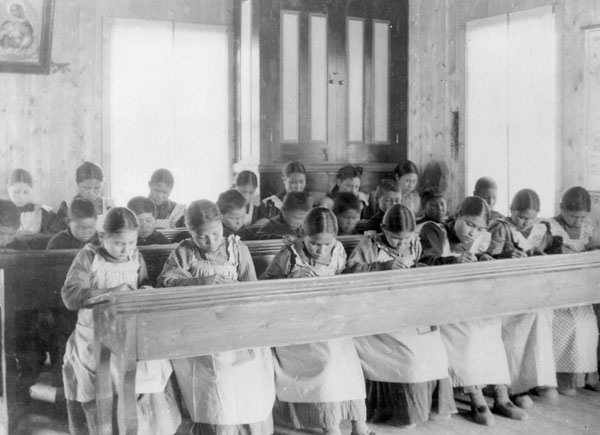
Study period, Roman Catholic Indian Residential School, Fort Resolution, N.W.T. The children the police delivered. (Public domain, Library and Archives Canada, via Wikimedia Commons)

Why is this important? Well, it is more important than being a national holiday for people to have a day off work or classes. My family, the Longpré clan, arrived from France in the late 1600s. The place wasn’t empty. People were already living here. My European ancestors from both paternal and maternal lines were not exactly friendly to the people already living here. The same was true for other European settlers. The competition for the land and its resources began almost immediately.

Somehow, being White and presumably Civilized made us feel entitled to what these people had. To be honest, we wanted everything and if possible to rid the planet of these “others.” We put them on reserves after creating a police force, an internal army first called the North-West Mounted Police. The name changed over the years, Royal North-West, then Royal Canadian Mounted Police, the RCMP, but the work stayed the same: to take care of these people. Taking care meant rounding them up and pushing them off the land where they lived and raised families for hundreds if not thousands of years. And taking care later meant taking their children, pulling them from their families and delivering them to residential schools.

While our paramilitary force did the work, we washed our hands of our complicity and now claim innocence. We even dare to say that this history is a lie. After all, if it were true then none of us can escape being culpable.

What do we do now, especially since this day exists? Admit the truth of the past. Admit that we as a society have profited and lived good lives because our society built our present country on persecution.