Family History & Genealogy

Problems With Research Even AI Can’t Solve

Quevilly 1685 – Revocation of the Edict of Nantes

In the late 1600s, especially on frontiers, during wars, migrations, religious persecution, epidemics, and displacement, people could be:

  • born with no surviving record,
  • married with no surviving record,
  • have children with no surviving record,
  • die with no surviving record,
  • be buried with no surviving record.
  • And not because records were destroyed later.

No matter how many genealogy sites I search, even with the help of AI [more than one – Gemini, Claude, Augure, Copilot, ChatGPT, and a few others] some people just can’t be found. Humans over time, and still today, do everything to hide their identity. People just vanish without a trace. And personally, I don’t blame them.

For example in 1837/38 there was a rebellion in Quebec [Lower Canada at that time]. The rebels lost. Some were executed, others fled to the USA, some simply disappeared into the bush and changed their names and no one challenged their new assumed identities.

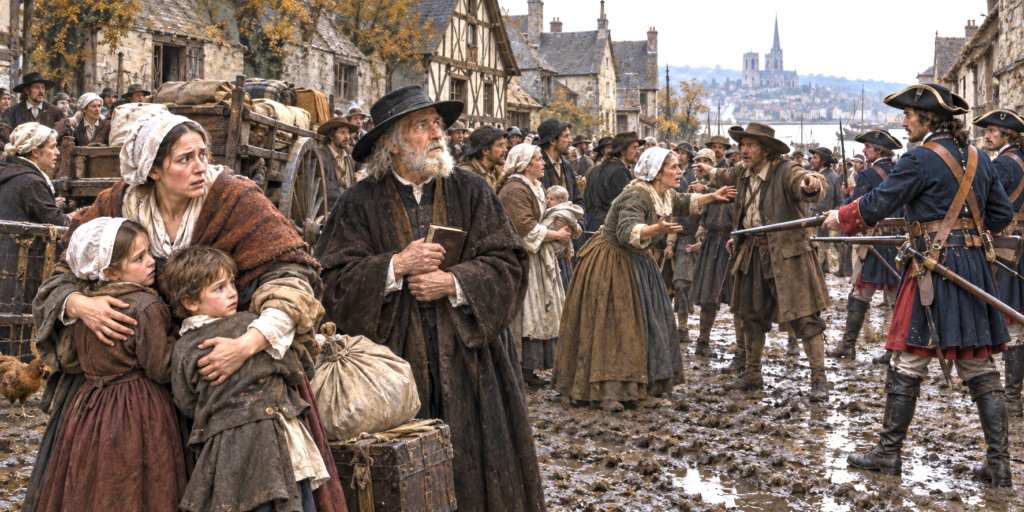
Now, I want to step back in time to the late 1600a – in France. There is a religious war raging. Catholics, with the blessing of the King, were attempting to wipe out all protestants [Huguenots]. Churches and communities were demolished and with them their records. People flee the country. It’s a scenario being played out today in too many countries causing worldwide refugee/immigration problems. Nothing new and historically correct.
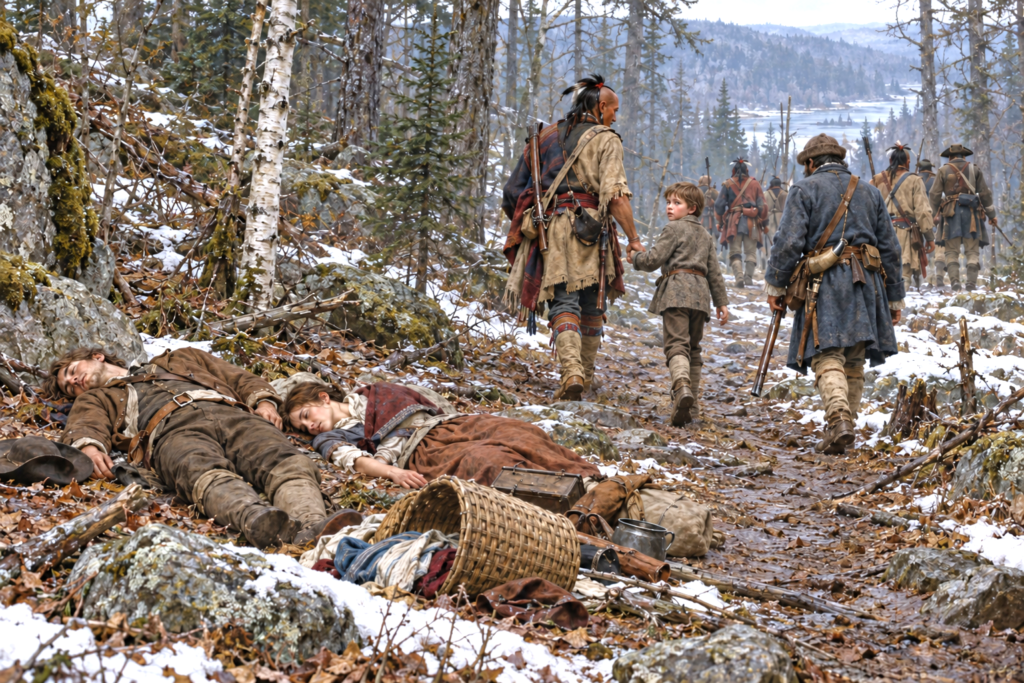
Young Guillaume Allard dit Longpré being kidnapped

There are two individuals Guillaume Longpré and Jeanne Allard who were living in Quevilly, a suburb town of Rouen, France. The main temple for the Huguenots [Calvinist protestants] was in this town. This was possible because of the Edict of Nantes which ended a long religious war. That Edict of Nantes was revoked on October 22, 1685. All hell broke loose. Another religious war began. The Huguenots fled for their lives. The records and their churches were destroyed in France. Guillaume and Jeanne fled to New England [Boston, Massachusetts]. In 1689 they had a son they named Guillaume. In 1704, while living in the frontier, Guillaume senior and Jeanne disappeared, presumably killed and the young Guillaume was taken to a Mohawk village by Montreal. Sixteen years later, this boy marries a girl named Catherine Bleau. It is there and then when the Longpré family returns to being documented people.

For the record, nothing about New Oxford or Deerfield stories fit any record of these two refugees from France.
Family History & Genealogy

Unravelling The Past

A book written by Yann Longpré

Like most families, the Longpré family has issues in tracing ancestors. For the longest time we wondered if we are even part of the Longpré clan as my great-grandfather carried the name Lampron which was passed on to my grandfather. However the family name was changed to Longpré. So which family do we actually belong to?

Well, to be honest, there is a marriage certificate between a Joseph Lampron and a Louise Lord in 1866. Louise was my great-grandfather’s mother. It seemed “game over” for the debate. Accept, there was this issue of DNA relations that are all from the extended Longpré family going back to a marriage between Guillaume Longpré and Catherine Bleau. Every branch of the family from that couple has provided a large group of DNA relations. The waters became muddy all over again. Now to be fair, I have more than 37,000 Ancestry DNA tested individuals from my father’s line.

That’s a lot of contacts, too many for me to deal with, so I got AI involved. Long story short, there are no DNA matches found in the Lampron clan. None! There is a story that Joseph Lampron married a pregnant Louise Lord, yes, stuff happened even back in the past. Now, just to figure out who impregnated the young woman, DNA was cited that it had to be a Longpré or else the huge number of Longpré clan couldn’t exist. If it was neither a Longpré or a Lampron, then neither clan would be our family.

Given the overwhelming DNA evidence, a reluctant AI was forced to admit that there was no probability of Joseph Lampron being a biological father to Raphael Lampron/Longpré. More than that, the probability of it being a male Longpré as the father was near unanimous. Yet, AI was reluctant to let go of Joseph Lampron because of the marriage certificate. AI wants everything cleanly documented and searched for days for a document which would have a different Joseph [Joseph Allard dit Longpré], son of Jérôme Allard dit Longpré, admitting in writing that he impregnated Louise which then led to her parents marrying her off to a younger man, Joseph Lampron. Good luck ever finding such a document.

So, the task became clear. What does the DNA trail story tell for all the descendants of Jérôme? Strangely, a host of DNA relationships. Case closed. We are indeed Longpré. I already had some proof of this before I began as my friend Yann Longpré published a two-volume book filled with as close to all the names of the Longpré clan as could be found. And yes, he arrived at the same conclusion, years before AI had done the same for me.